


Scout
TOOLS USED


DURATION
2.7 weeks
MY ROLE
UX/UI DESIGN & RESEARCH.
Overview
The Problem
Shifting to a new place without knowing detailed information about it, costs so much to people. They easily fall for their mediators who introduce them with only good parts of surrounding regardless of any bad part which later on cause them some serious mental health issues.
Solution
My solution was all an one information app that provides users with all the reviews, whereabouts, and what about of their chosen place by none other than the locals living there itself that involves no mediators in between. By having all the information in one place, this app would save user's time, limit their concerns, and would meet them with the correct information necessary to get shift into a place.


How might we increase security for people shifting to a new place?
"
"
Defining The Problem
People aged from group 19 to 38 were the most migrating ones and above 38 holds an average rate of migration. They both share a similar way of finding new places but with different pattern varies from local to professional mediators.
Why do users include mediators at first place?

*lack of info

*lack of time

*trust on experience
Project Timeline
01
Empathize, Define
Understanding space
Defining project goal
Project Timeline
02
Research
Competitive Analysis
User Interviews
Contextual Inquiry
Survey
Personas
Task Analysis
Journey Map
Affinity Mapping
03
Design, Prototype
Initial design idea
User flow
Sketches
Wireframes
Feedback session
Visual Research
Final Design/hi-fi
Research
RESEARCH METHOD USED

Competitive Analysis
Secondary

Semi- Structured interviews(3)

Contextual Inquiries(3)

Survey
Primary
Competitive Analysis
I looked at online feedback and property platforms that existed in the market. Limitations with these were being an absence of an interactive panel for users and reviewers, it's only available to read, share, or like, and the reviews there, were made more than a year before.
Outcome: It was concluded that there is no existing technology that is widely adopted among users in feedback platforms, and the market is open for innovation in this space.

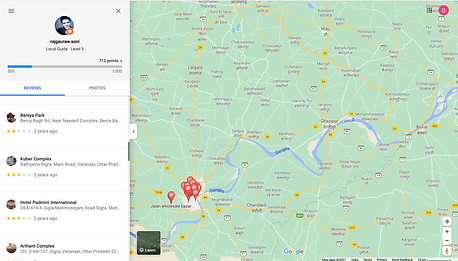
existing reviews platform
User Interviews & Contextual Inquiries
(3 User Interviews + 3 Contextual Inquiries)
Interviews included a provocation participatory activity to gather rich qualitative data and also conducted two contextual inquiries with users (shifting/shifted to a new place) and one with the reviewer.
Goal: To get a detailed understanding of the search flow process of user, task by task, including emotional pain points and experience with mediators (if had any).
Outcome: Gained valuable insight regarding users' search flow process, and learned about reviewer's privacy concerns, its consequences, and their limitations regarding reviews.
Relevant Findings
Reviewers limit
Reviewers can only review at a limit so it doesn't cause them any later impact of it. Design Implication: Publicly reviewing every info may not be suitable with this condition.
Difficulty in locating local residents
The process of finding new place differs for everybody, approaching locals personally or digitally may directly lead to report (if it is not familiar or professional).
Falling for mediators
Users constantly rely on mediators for their entire search flow process- telling requirements, cross-checking place, and documenting all processes.
Survey
Goal: To get a common understanding about users mindset regarding new places, their way of decision making, including their common trigger points.
Outcome: Gained quantitative insight regarding user's thought processes and learned about user's self-doubt, insecurity, and mediators impact on them.
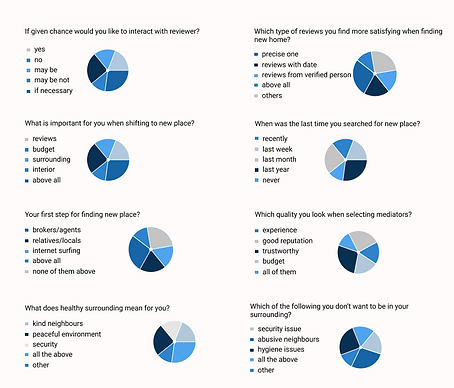
scout- survey
Relevant Findings
Users self doubt
Users were more afraid of themselves from missing best deals, facilities, place, budget, and their trust on experience that later on involve mediators automatically. Design Opportunity: Users need to boost their confidence by having every opportunity uplisted at the front.
Lots of work leads to no work
From searching to reviewing to visiting to cross-checking to buying includes lots of work and time which in bunch loose users interest
Personas & Empathy maps
Outcome: Using the data from interviews, contextual inquiries, and surveys, I was able to create 2 distinct types of visual users involved in this problem and efficiently summarized their needs and goals. I used these personas when designing to ensure that my solution looped back to the needs and goals outlined in them.


Task Analysis
Outcome: This task analysis outlines every single task and decision a user makes throughout its way in finding a new place. This process flow is important because by visualizing all the steps in one graphic, I was able to focus on the pain points (highlighted in blue), and can clearly identify potential areas in which i could improve more.

Journey Map
Outcome: Using the task analysis, created an in-depth journey of users' search flow process. This allowed me to uncover more findings of their emotional journey, especially on interaction with mediators.

Relevant Findings
Mediators pros
Users feel more relieved when hiring mediators as they came with assurance and a fixed package of time.
Initiating Reviewers
Users get confused when initiating conversations with reviewers. Design opportunity: providing initiative pre-quoted message highlighting some major concerns would definitely go with this situation.
Expanding Reviewers
expanding reviewers to near shops to the watchman to workers, etc would not only bring precise data but also decrease chances of getting conned.
Affinity Mapping
Categorized the qualitative and quantitative data from research activities into an affinity map to make sense of the data. It amounted to ~110 post-it notes worth of data!

Design
Design Opportunity
After forming research findings, I came up with three main features that tackled the problem space, yet still related back to the ultimate goal of removing mediators.
The ideas generated came directly from research insights. These areas included addressing pain points in user's search flow, improving their process, limiting their time and concerns. From there, I converged the ideas into 3 separate concepts that together in one app will tackle multiple areas of the pain points discovered.
RESEARCH FINDINGS
MAIN PAIN POINT
GENERATED IDEAS
Difficulty in locating locals
Falling for mediators
complicacy and workload
easy and direct search flow
Users self doubt
Lots of work leads to. no work
lack of progress and appreciation
visible status bar
Reviewers limit
fear of consequence
public and private mode of interacting reviewers
Userflow
.jpg)
Sketches

paper iteration


.png)


.png)
Feedback Session
"Can i connect with this person and get more detail about this incident" ( talking about public reviewer)
"How am i suppose to know more about this incident" (talking about public reviews)
"oh! i have to check reviews seperately" (talking about info page)
get frustrated at signup page
confused sign up with login page
confused between public reviews with personal one
"its good"
conclusion & reccomendation
users confuse signup page with login, so highlighting it with different colour would do the work.
providing reviews up at front and other details beneath it would tackle the review search for user.
Provide additional option to add public reviewers so users can dig into their written incidents.
average
Time Taken
less than average
Task Difficulty
easy
Flow efficiency
#design changes based on reccomendation
Before


.png)
After
Visual Research
Moodboard

Styleguide
.png)
.png)
.png)
Logo and Naming
.png)
FINAL Design
High Fidelity screens





Prototype

(a)

(b)
Feature &.Visual Breakdown

REFLECTION
Lessons Learned
Understanding the difficulty in designing for varied users
In designing a solution for general home finders, I quickly realized that actions and processes among users regarding this idea are not standardized at all. For instance, my solution was designed with the notion that feedback apps were out there but not widely used, and the reviewers around the dummy place I talked to were highly conservative and confidential in terms of reviewing. When I interviewed users (home finders) for the very same dummy place, I learned that they were using unprofessional local mediators for the majority of their operations without cross-checking, so the impact of my app solution from their perspective was far greater and different.
The importance of feasibility in considering a potential solution
At the beginning of this project, there was a big cross-path between reviewers and users (home finders). However, once I conducted the contextual inquiry, which include numbers, personal details, and paid reviews like demands as a solution from users and reviewers which was clearly declined by both parties when swapped. This research finding was particularly important for me because it served as a reminder to take a step back from unrealistic expectations as research might prove there to be a better solution out there.